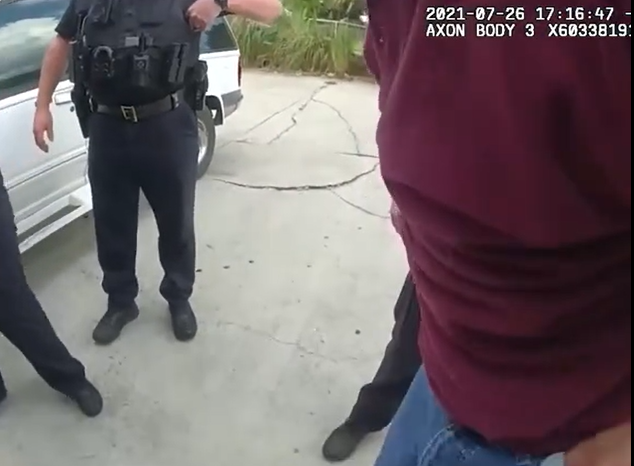
The uploaded video, titled “GOOD COP STANDS UP AGAINST CORRUPTION PART 1,” plunges the viewer immediately into a tense and highly controversial police arrest. While we only witness the initial confrontation, the footage itself is a powerful study of the use of force, procedural integrity, and the conflict suggested by its provocative title.
The Anatomy of the Arrest
The video begins with an officer escalating the encounter by drawing a firearm and using aggressive, high-stress commands. The individual being arrested is quickly forced to the ground, handcuffed, and searched. Several key moments in the footage raise immediate questions about the officers’ conduct:
The Unfounded Claim: The arresting officer repeatedly insists there is a “gun” and cites this as the justification for the escalated use of force. However, the officer conducting the actual search explicitly states, “No gun by that truck,” and “Ain’t got no gun.” This factual disagreement within the arresting team is the narrative’s central point of friction.
Use of Force and Injury: The individual claims, “You threw me down!” and alleges his head was injured, stating, “Y’all bust my head out!” Crucially, he repeatedly mentions having a disability and a “head problem,” suggesting the officers were aware of his vulnerable status and yet proceeded with a forceful takedown.
The Paradox of the Title
The title, “GOOD COP STANDS UP AGAINST CORRUPTION PART 1,” frames this footage not as a simple police blotter incident, but as the opening act of an internal conflict.
Who is the “Good Cop”? The title forces us to scrutinize the officers present. Is it the officer who failed to find the gun and refuted the initial claim? Is it an officer whose body camera we are not seeing? The most likely implication is that one officer (the “Good Cop”) is actively documenting or reporting the misconduct of the officer who used excessive force based on a false premise.
Defining “Corruption”: In this context, “corruption” may not refer to financial bribery, but to the abuse of power and a breach of professional integrity. An unwarranted, aggressive arrest predicated on a false claim of a weapon, coupled with physical injury to a vulnerable person, is the very definition of misconduct that a principled officer would feel compelled to report.
The Unfinished Story
This video is a raw, jarring Part 1. Its true significance lies in the promise of the narrative to come. The video’s message is that the accountability mechanism—the “good cop”—exists within the system.
This footage serves as a stark reminder of the essential role of body-worn cameras and the individuals who use them to enforce ethical standards. It is not just the recording of a crime or an arrest, but the documented moment where a claim of misconduct is directly challenged by evidence and by the words of another officer. The “corruption” here is the potential cover-up or justification of an unwarranted action, and the “good cop” is the one who will, ostensibly, prevent that justification from holding water.