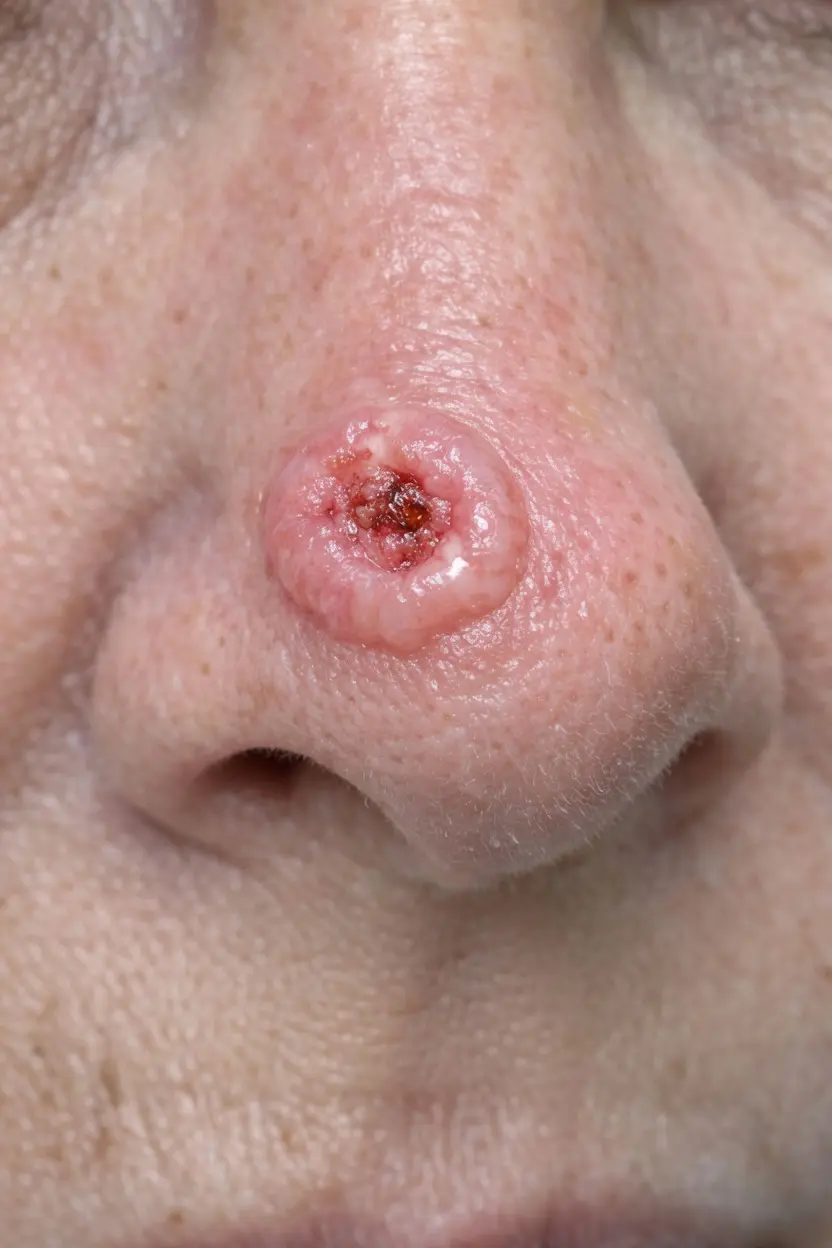
There’s a particular kind of worry that sets in when you notice something on a parent’s face that shouldn’t be there. A small sore on the nose, one that scabs over, looks like it’s about to heal, and then bleeds again a few days later. You point it out. She shrugs it off. You try to book an appointment and the first opening is six weeks away.
If that’s where you are right now, you’re not overreacting. A sore that refuses to heal — especially on the nose — is exactly the kind of thing that deserves attention, and there are real steps you can take while you wait. Here’s what you need to know.
Why This Pattern Is Worth Taking Seriously
Healthy skin heals. A scratch, a pimple, a bug bite — all of them run through their cycle and disappear, usually within a couple of weeks. When a sore sits in the same spot for a month or more, bleeds easily, scabs, and then reopens, something in the normal repair process is being interrupted.
On the nose specifically, the most common explanation for that pattern is basal cell carcinoma (BCC), a slow-growing form of skin cancer. That sentence sounds alarming, so let’s slow down on it: basal cell carcinoma is the most common skin cancer in the world, and it’s also one of the most treatable when caught early. It very rarely spreads to other parts of the body. What it does do is keep growing locally if ignored, which on a face means potential tissue damage that’s much harder to repair later than it is now.
This is why the “won’t heal” part matters more than how big or dramatic the sore looks.
Why the Nose Is Such a Common Spot
The nose sticks out. That’s not a joke — it’s the whole reason.
Every time your mom has stepped outside without sunscreen in her life, her nose caught more UV radiation than almost any other part of her body. Decades of that exposure cause DNA damage in the basal cells at the bottom of the skin’s outer layer, and eventually some of those cells can start dividing abnormally. The face, ears, scalp, and the tops of the hands are the classic locations for the same reason.
Fair-skinned people, people who sunburned easily as kids, outdoor workers, and anyone who spent significant time in tanning beds are all at higher baseline risk. But BCC can show up on anyone.
What These Lesions Usually Look Like
Basal cell carcinoma doesn’t have one single look, which is part of why people miss it. The common presentations:
- A pearly or waxy bump, sometimes with tiny visible blood vessels running through it
- A flat, scar-like patch that’s flesh-colored, pinkish, or slightly brown
- An open sore that bleeds, crusts over, and reopens — the classic non-healing pattern
- A reddish, slightly scaly patch that can look a bit like eczema or a stubborn dry spot
The one on your mom’s nose sounds like the third category, which is probably the most recognizable form and also the one most people dismiss as “just a scab.”
Other warning signs worth noting: irregular borders, a spot that itches persistently, any new growth that looks different from the surrounding skin, or a lesion that’s slowly gotten bigger over months rather than weeks.
It Might Not Be Cancer — Other Possibilities
Before you spiral, it’s worth knowing that a few other conditions can produce similar-looking sores:
Actinic keratosis — rough, scaly patches from long-term sun damage. Considered precancerous but not cancer yet.
Seborrheic keratosis — benign, waxy growths that can sometimes get irritated and bleed if rubbed.
Impetigo or a bacterial infection — usually painful, often with yellow crusting, and typically clears with antibiotics.
Herpes simplex (cold sore) — recurrent in the same spot, tingles before appearing, usually heals in one to two weeks.
Chronic picking or irritation — if your mom unconsciously touches or picks at the spot, it can’t heal. This is more common than people admit.
The catch is that you can’t reliably tell these apart from BCC just by looking. Even dermatologists often need a biopsy to be certain. So while “it might be something minor” is genuinely possible, it’s not something to bank on without a professional opinion.
Why Waiting Gets Harder, Not Easier
Basal cell carcinoma is slow. That’s the good news and the trap at the same time.
Because it grows gradually, people watch a spot for months or years, telling themselves it hasn’t changed much. Meanwhile the lesion is working deeper into tissue. Caught early, a BCC on the nose is often removed in a single office procedure with a small scar and no drama. Caught two years later, the same lesion can require more extensive surgery to remove cleanly, and reconstructing skin on the nose is considerably more complex than on other parts of the body.
Early doesn’t just mean safer medically. It means a better cosmetic outcome too — which matters when we’re talking about someone’s face.
What to Do While You Wait for an Appointment
If the regular dermatology clinic is booked out, you have more options than it might feel like:
Call your mom’s general practitioner first. A GP can often take a look, refer to dermatology with an “urgent” flag that moves her up the list, and sometimes skip the booking queue entirely.
Use telemedicine or a dermatology-specific online service. Many services let you upload photos and get an opinion within 24 to 72 hours. It’s not a biopsy, but a dermatologist reviewing clear images can usually tell you whether this needs fast-tracking.
Ask about cancellation lists. Most clinics maintain one. If someone cancels a morning-of appointment, you can sometimes slot in the same day.
Check for walk-in or urgent dermatology clinics. They exist in most larger cities and are built precisely for situations like this.
Document as you wait. Take a clear, well-lit photo every three to four days from the same angle. Measure the lesion with a ruler next to it. Note any changes — bleeding, size, color, whether it’s itchy or painful. This log will be genuinely useful for whichever doctor eventually sees her.
What to Mention When You Finally Get the Appointment
The more precise you are, the faster a doctor can make a decision. Useful details to have ready:
- How long the sore has been present (best estimate is fine)
- Whether it’s grown, changed color, or changed shape
- Whether it bleeds on its own or only when touched
- Any itching, pain, or tingling
- Your mom’s history of sun exposure, blistering sunburns as a child, tanning bed use
- Any family history of skin cancer, especially on her side
- Her general skin type and how easily she burns
What Treatment Usually Involves If It Is BCC
If the biopsy comes back as basal cell carcinoma, the treatment options are well-established and most are handled in an outpatient setting:
Small, superficial lesions can often be treated with cryotherapy (freezing), a topical cream like imiquimod, or curettage and electrodessication (scraping plus a mild electric current to seal the tissue).
Most lesions on the face, especially the nose, are treated with Mohs micrographic surgery. This is the gold standard for facial BCC. The surgeon removes the cancerous tissue layer by layer, checking each layer under a microscope until they hit clear margins. It preserves the maximum amount of healthy tissue — which, again, matters a lot on a face.
More advanced cases may involve radiation therapy or, rarely, targeted drug therapy. These are uncommon for standard BCC caught at a reasonable stage.
Most people walk out the same day, with stitches and aftercare instructions, and the scar fades significantly over the first year.
Handling the Emotional Side
You’re scared. Your mom is probably scared too, even if she’s pretending she isn’t. That fear is going to sit with both of you until you have answers, and there’s no trick to make it disappear.
What helps: being honest about what you know and don’t know. Not catastrophizing — most sores like this turn out to be treatable. Not minimizing either, because brushing it off can feel dismissive. Just sitting with the reality that something needs to be checked, and you’re going to handle it together.
Offer to go to the appointment with her if she’d like. Handle the logistics — calling the clinic, driving, taking notes during the visit. Someone who’s worried about their own health often can’t process medical information in real time, and having a second set of ears matters.
And give yourself some grace too. Worrying about a parent is exhausting.
Protecting Her Skin Going Forward
Whatever this sore turns out to be, it’s a prompt to think about longer-term skin care. The steps are simple and don’t require any expensive products:
- Broad-spectrum SPF 30 or higher on her face every morning, even in winter, even when it’s cloudy
- A wide-brimmed hat for any time outdoors for more than a few minutes
- Avoiding peak sun hours between roughly 10 a.m. and 4 p.m. when possible
- Long sleeves and sun-protective clothing during outdoor time in strong sun
Once every month or two, help her do a quick skin check — arms, legs, chest, back, scalp, and especially the face, ears, and hands. Take a mental note (or an actual photo) of anything new or changing. People who know their own skin catch problems years earlier than people who don’t.
The Bottom Line
A sore on the nose that bleeds, scabs, and won’t heal after four weeks needs a professional look, even if you have to work a bit to make that appointment happen. It may turn out to be something simple. If it does turn out to be basal cell carcinoma, catching it now rather than six months from now is one of the most meaningful things you can do.
You’re already doing the right thing by paying attention. Keep pushing for the appointment, keep documenting the changes, and don’t let the booking difficulty be the reason it goes unchecked. Your instincts are sound.